
BPC-157 and Systemic Inflammation: User Reports, Animal Evidence, and Unconfirmed Mechanisms
Key Points
Both research and user datasets show a significant association between BPC-157 and inflammation.
Most users did not report symptoms disappearing suddenly, but rather lower baseline stiffness and milder inflammatory episodes.
"Reducing inflammation" has become one of the most overused terms in the peptide online community.
Inflammation may play a role in several of these effects, but its specific biological mechanism in humans remains unclear.
1. Inflammatory Improvements in User Reports
Both research and our dataset show a significant association between BPC-157 and inflammation.
Most users did not report symptoms disappearing suddenly after taking corticosteroids or NSAIDs.
Instead, they found lower baseline stiffness, milder inflammatory episodes, faster between-training recovery, and less residual inflammation. They also found better exercise tolerance and less irritation after joint or muscle loading.
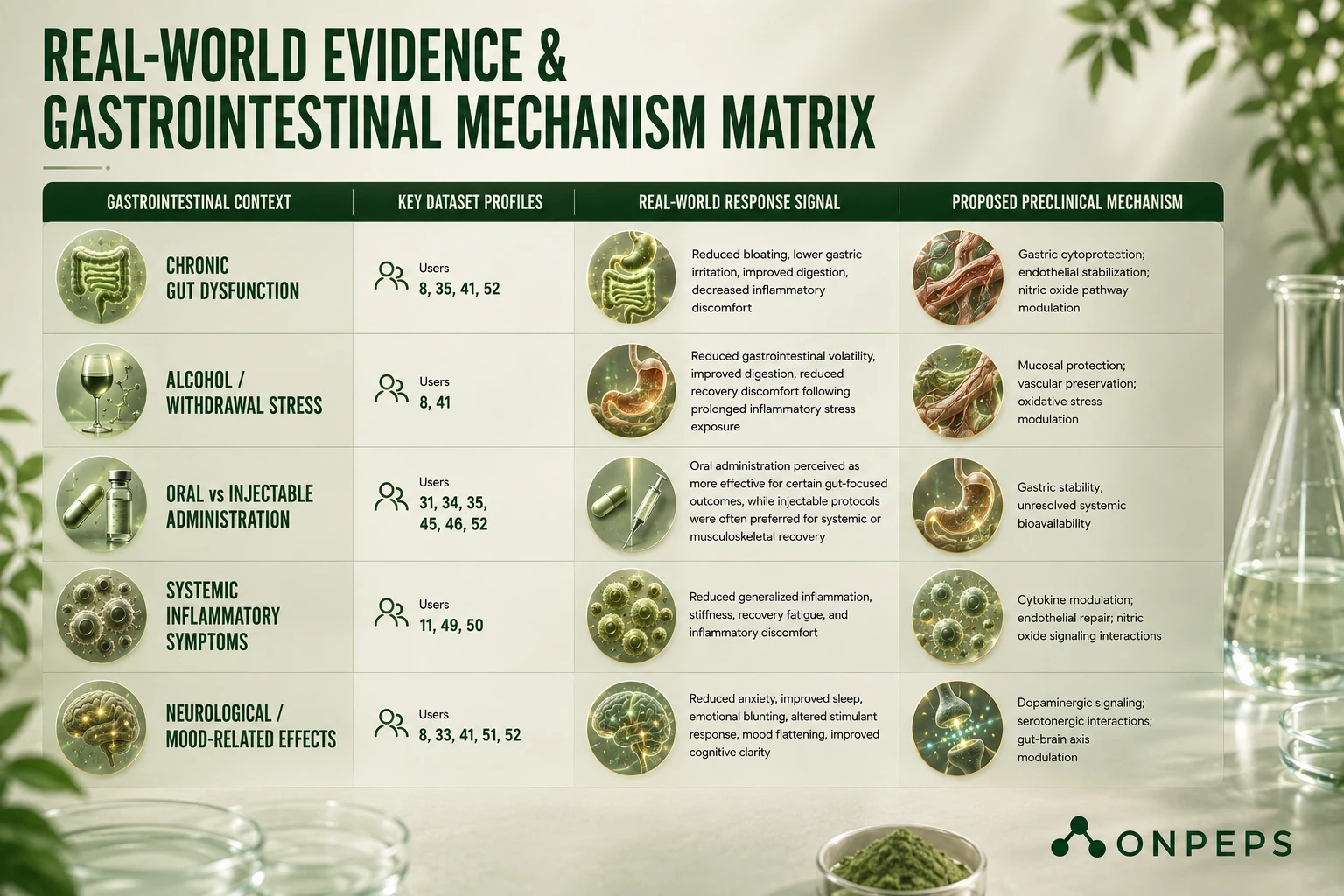
User 11 described a significant overall reduction in inflammation, increased mobility, and reduced daily pain during combination peptide therapy.
User 49 reported reduced knee inflammation, enough to postpone discussions about knee replacement surgery, and also described reduced menopausal symptoms and hot flashes during treatment.
User 50 described a similar situation, with rheumatoid arthritis pain almost gone and reduced use of blood pressure medication.
2. Why We Should Not Jump to Conclusions
But like everything else, we should not jump to conclusions. "Reducing inflammation" has become one of the most overused terms in the peptide online community.
Users seem to attribute everything to it: pain, weight, mood, sleep, recovery, stiffness, and digestion.
But the evidence does not support this. Inflammation may play a role in several of these effects, but its specific biological mechanism in humans remains unclear.
3. The Analgesic Mechanism of BPC-157
This also relates to BPC-157's analgesic mechanism. Animal studies show that BPC-157 can relieve early severe pain but is ineffective against the slower, longer-lasting pain phase.
After surgery in rats, BPC-157 raised the pain threshold early, but this effect disappeared within about a week.
In a standard thermal pain test, BPC-157 had no effect at all. Researchers believe that pain relief after BPC-157 use mainly comes from suppressing inflammation, rather than directly blocking pain signals.
There was even a surprising result: when BPC-157 was given to mice already treated with morphine, it actually weakened morphine's analgesic effect.
So the claim that BPC-157 magically cures all pain is questionable.
4. Cytokine Modulation and Endothelial Repair
Proposed preclinical mechanisms include:
Cytokine modulation
Endothelial repair
Nitric oxide signaling interactions
These mechanisms currently come mainly from animal research and have not been fully validated in humans.
5. Summary
The association between BPC-157 and inflammation is a direction repeatedly mentioned in both user reports and animal research.
But it must be emphasized:
First, user reports are self-reports, not results from controlled studies.
Second, animal research shows early pain relief, not long-term analgesia.
Third, inflammation may be involved, but the specific mechanism remains unclear.
Understanding these points helps provide a more rational view of BPC-157's role in inflammation and recovery.
Frequently Asked Questions
Can BPC-157 directly block pain signals?
Animal research suggests it mainly works by suppressing inflammation rather than directly blocking pain signals. In a standard thermal pain test, BPC-157 had no effect at all.
How long does it take for BPC-157 to improve inflammation?
User reports suggest effects typically emerge gradually, manifesting as lower baseline stiffness and milder inflammatory episodes, rather than symptoms disappearing suddenly.
Does BPC-157 affect cytokines?
Under laboratory conditions, BPC-157 has been shown to calm the immune system by reducing major inflammatory signals in the body. But these effects still need to be validated in human trials.
Why should the claim of "reducing inflammation" be treated with caution?
Because user reports are not controlled study results, and the specific biological mechanism of BPC-157 in humans remains unclear.