
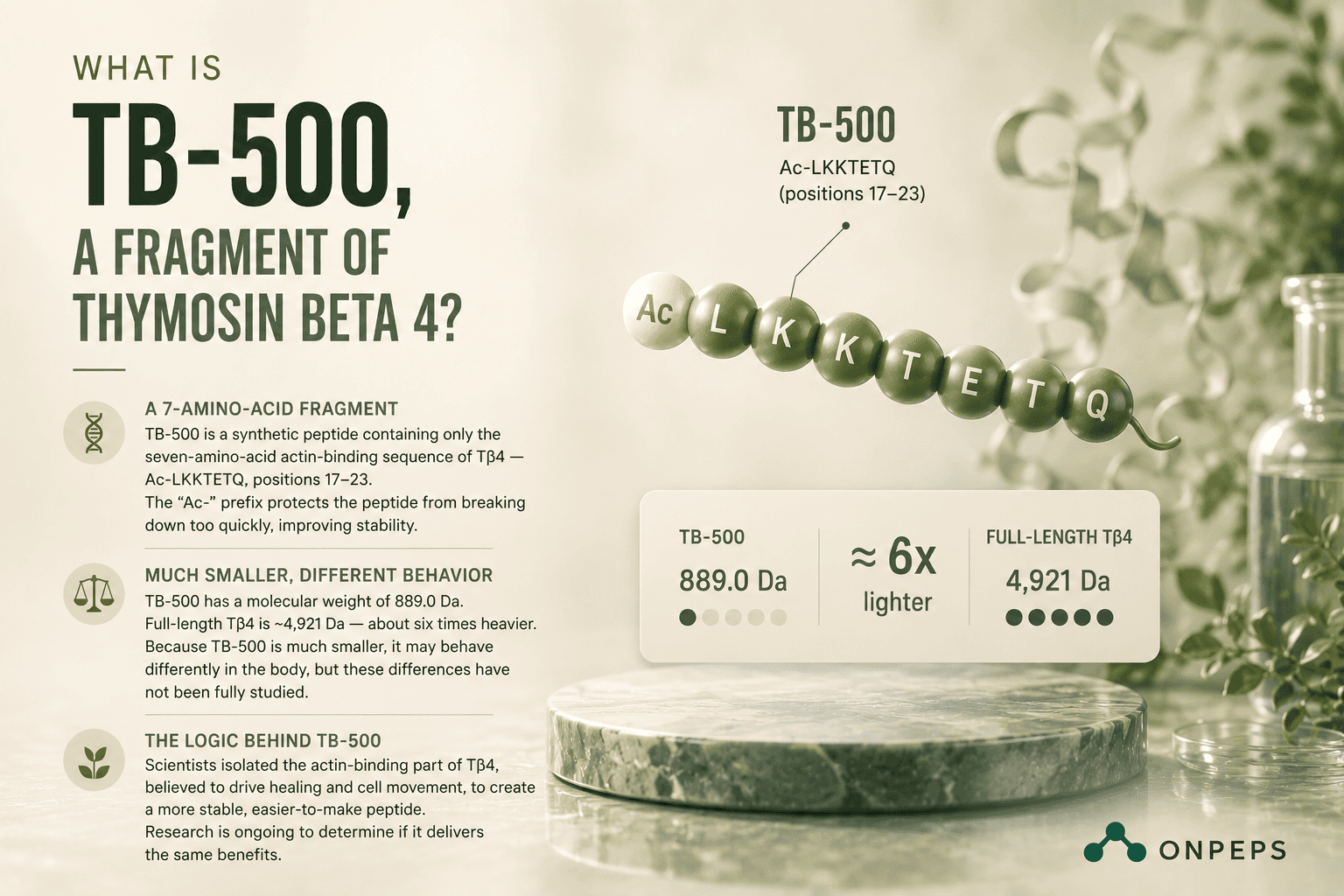
TB-500 is a synthetic peptide containing only the seven-amino-acid actin-binding sequence of Tβ4 — Ac-LKKTETQ, positions 17–23. The “Ac-” prefix is a small chemical modification added to the beginning of the peptide. It helps protect TB-500 from breaking down too quickly, making it more stable than the same peptide without it.
Molecular weight difference
TB-500 has a molecular weight of 889.0 Da. Full-length Tβ4 is approximately 4,921 Da, which is roughly six times heavier.
Because TB-500 is much smaller than full-length Tβ4, it may behave differently in the body. It could be absorbed, distributed, broken down, and interact with cells differently, but these differences have not been fully studied.
Design logic
The logic behind creating TB-500 was not that complicated. Scientists believed that they could isolate the actin-binding part responsible for healing and cell movement. This would help them create more stable and easy-to-make peptides. Research is still ongoing as to whether it offers the same benefits.
What it may be missing
Because TB-500 contains only one small part of the full Tβ4 protein, it may not reproduce all of the biological effects seen with full-length Tβ4. Functions mediated by other regions of the full protein — such as cardiac repair, anti-scarring, and cell survival — may not be fully replicated by this fragment.
Conclusion
TB-500 is not a “mini” version of thymosin beta-4, but a structurally simpler synthetic fragment with a narrower functional range. Understanding this is essential for evaluating its actual value.