
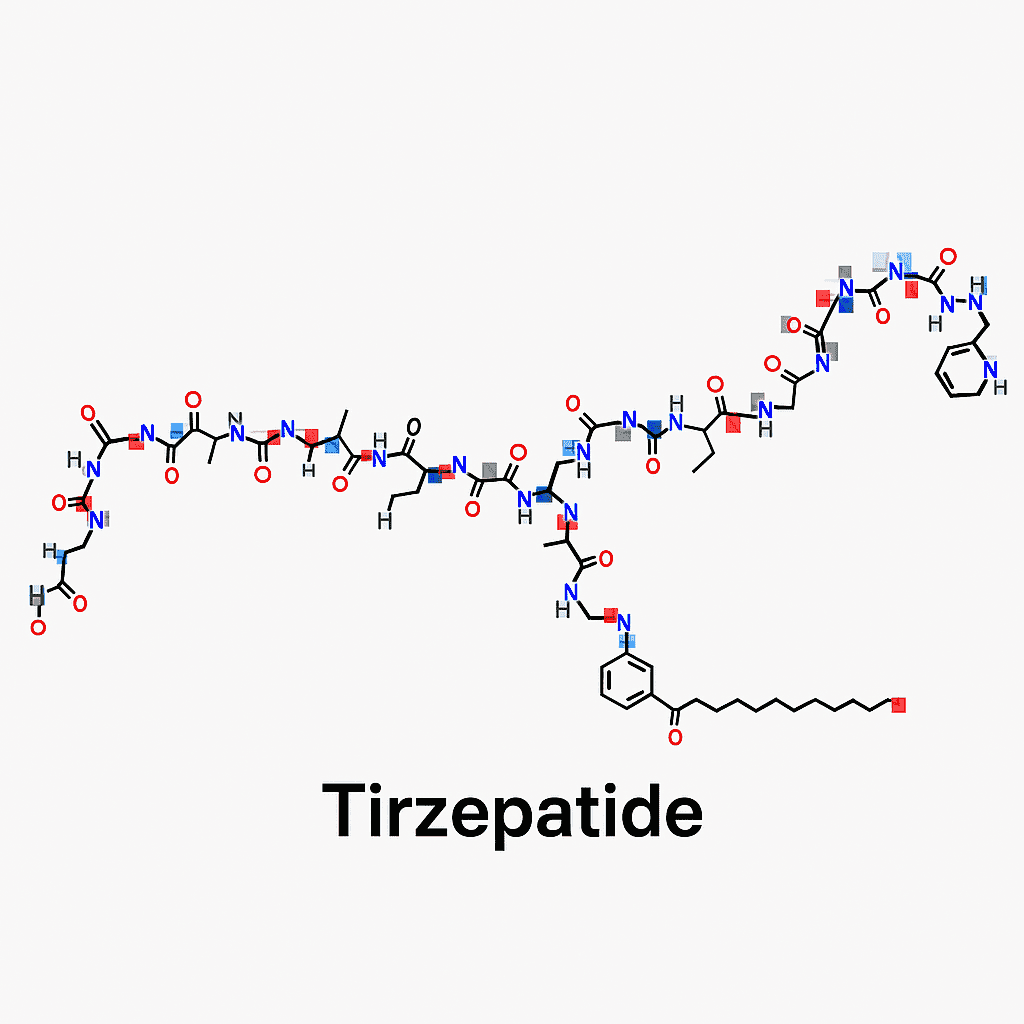
Tirzepatide: A GIP/GLP-1 Dual Agonist, or Just a "Super" GLP-1?
The obesity epidemic poses a major challenge to human health. Traditionally, strategies for treating obesity have focused on dietary and lifestyle changes, such as restricting calorie intake and increasing physical activity. Clinically, the development and use of anti-obesity/weight-loss drugs have long been viewed with high expectations, yet they face enormous technical challenges. Due to a series of serious adverse effects, the safety of weight-loss drugs has long been questioned. For patients with severe obesity, bariatric surgery remains the most effective means of achieving weight loss.
The incretin hormones glucose-dependent insulinotropic polypeptide (GIP) and glucagon-like peptide-1 (GLP-1) mediate insulin responses proportional to nutrient intake, thereby promoting glucose tolerance. GLP-1 receptor (GLP-1R) agonists have long been used to treat diabetes. In patients with type 2 diabetes, GLP-1R agonists can restore insulin production to lower blood glucose, and reduce body weight by increasing satiety and decreasing appetite. In recent years, GLP-1R agonist drugs represented by the globally popular weight-loss drug semaglutide have demonstrated the possibility of being safe, tolerable, and suitable for long-term use. However, although GLP-1R agonists produce significant weight loss, their efficacy remains insufficient compared with that of bariatric surgery.
Tirzepatide is a diabetes treatment developed by Eli Lilly. It is a dual agonist of the GIP receptor (GIPR) and GLP-1R. In addition to activating GLP-1R, tirzepatide also activates GIPR, reducing food and calorie intake and increasing energy expenditure. However, for a long time, GIPR was not regarded as a therapeutic target for metabolic diseases, and some in the field speculated that tirzepatide might simply act as a "super" GLP-1R agonist. Is that really the case?
On June 5, 2023, researchers from Duke University, the German Center for Diabetes Research, and Eli Lilly co-published a paper titled "The incretin co-agonist tirzepatide requires GIPR for hormone secretion from human islets" in Nature Metabolism, a Nature sub-journal. The study revealed different effects of tirzepatide in mouse and human islets: in mouse islets, tirzepatide mainly stimulates insulin secretion through GLP-1R, whereas in human islets, tirzepatide stimulates insulin secretion through both GLP-1R and GIPR. Tirzepatide can also enhance glucagon and somatostatin secretion from human islets.
1. In mouse islets, tirzepatide mainly stimulates insulin secretion through GLP-1R
Previous studies have shown that the GLP-1 sequence is consistent between rodents and humans, whereas the GIP sequence differs across species. Since tirzepatide is engineered from the human GIP (hGIP) sequence, the authors designed a more systematic experimental approach based on existing findings to comprehensively analyze the potency of tirzepatide at the mouse GIPR (mGIPR). The results showed that the affinity-potency of tirzepatide at mGIPR was 3–60 times weaker than that of mGIP, but at mGLP-1R it had potency similar to that of GLP-1. On the one hand, this finding suggests that the imbalanced activity of tirzepatide may actually favor GLP-1R signaling in mouse β cells; on the other hand, it indicates that the low potency of tirzepatide at mGIPR limits the use of mouse models to study tirzepatide function.
To investigate the effect of tirzepatide on insulin secretion in mice, the authors isolated islets from mice with β-cell-selective GIPR knockout and stimulated them with tirzepatide. The results showed that, compared with control islets, islets from β-cell GIPR knockout mice secreted more insulin upon tirzepatide stimulation, while the GLP-1R antagonist exendin(9-39) (Ex9) completely blocked tirzepatide-stimulated insulin secretion in both groups. The authors inferred that the enhanced insulin release in islets with β-cell-selective GIPR deletion was due to compensatory enhancement of GLP-1R signaling. This had been described previously in various GIPR gene knockout models. To address this issue, the authors next used acute antagonists of the incretin receptors, which can prevent the glucose-lowering response caused by acylated GIPR agonists in wild-type mice. The results showed that the combination of a long-acting GLP-1R antagonist with Ex9 prevented tirzepatide-stimulated insulin secretion, whereas GIPR antagonist alone or in combination with Ex9 did not affect tirzepatide-stimulated insulin secretion. These results indicate that tirzepatide mainly stimulates insulin secretion from mouse islets through GLP-1R.
To further determine the impact of these findings on glucose tolerance in mice, the authors pretreated mice with acylated antagonists of GLP-1R or GIPR alone or in combination, followed by tirzepatide and glucose tolerance tests. The results showed that before glucose administration, tirzepatide (3 nmol/kg) lowered fasting blood glucose, and GLP-1R (but not GIPR) antagonism or knockout significantly blocked the effect of tirzepatide. However, when 30 nmol/kg tirzepatide was used, GLP-1R antagonism only partially blocked the glucose-lowering effect of tirzepatide. In addition, although GIPR antagonism alone did not reduce the glucose-lowering effect of higher-dose tirzepatide, combined use of the two antagonists prevented the glucose reduction under tirzepatide. These data are consistent with previous results, indicating that in mice tirzepatide can interact with mGIPR, but only at high doses.
2. In human islets, tirzepatide stimulates insulin secretion through both GLP-1R and GIPR
The authors' above studies showed that in mouse islet cells, tirzepatide tends to bind and act through GLP-1R rather than GIPR. To further determine which receptor tirzepatide acts on to promote insulin secretion in human islet cells, the authors used a high concentration (30 nM) of tirzepatide for experiments. First, in islets from a representative donor, the authors found that GLP-1R antagonism did not reduce tirzepatide-stimulated insulin secretion, whereas GIPR antagonism reduced insulin secretion by about 55%. Due to differences among human sample donors, the authors repeated the experiment in another group of human islets covering donors with different body mass indices, ages, HbA1c%, and sexes. The results showed that the effect of GLP-1R antagonism varied depending on the islet source; in nearly half of the experiments, tirzepatide-stimulated insulin secretion was not reduced, whereas GIPR antagonism consistently reduced tirzepatide-stimulated insulin secretion in all donors. Combined use of the two antagonists produced an effect consistent with GIPR antagonist alone. These results suggest that the insulinotropic effect of tirzepatide is mediated by both receptors, but the contribution of each receptor varies by donor; the finding that GIPR antagonism reduced tirzepatide-stimulated insulin secretion in all islets indicates that GIPR activity is a necessary condition for tirzepatide-stimulated insulin secretion in human islets.
Tirzepatide stimulates glucagon secretion in human islets
In addition to β cells, α cells in islets also express GIPR and GLP-1R, and these two receptors regulate glucagon secretion. According to previous reports, the inhibitory effect of GLP-1R agonists on glucagon secretion exceeds the stimulatory effect of GIPR agonists, and the combined action of GLP-1 and GIP can reduce or offset glucagon levels. The authors found that in isolated human islets, hGIP promoted glucagon secretion, GLP-1 reduced glucagon secretion, and the combination of the two peptides offset each other, producing an effect consistent with unstimulated levels. Interestingly, the authors found that tirzepatide stimulated glucagon secretion to the same extent as hGIP, but the combination of hGIP and tirzepatide reduced glucagon secretion, suggesting a possible degree of desensitization. In addition, the authors found that GIPR (but not GLP-1R) antagonism completely blocked the ability of hGIP or tirzepatide to stimulate glucagon secretion. In all islets, although glucagon secretion levels varied among donors, tirzepatide consistently increased glucagon secretion. This finding suggests that in α cells, the effect of tirzepatide on the glucagon-stimulating function of GIPR exceeds its effect on GLP-1R-mediated inhibition of glucagon secretion.
Summary
This study is the first to use human islet cells to demonstrate that tirzepatide is a dual agonist of the GIP receptor and GLP-1 receptor, rather than merely a super GLP-1 receptor agonist. When stimulated by tirzepatide, the GIP receptor is necessary for insulin secretion and indispensable for glucagon secretion. The emergence of tirzepatide brings a completely new direction and possibility for humans to combat obesity and diabetes through multi-targeted agonists.