
How Do Cells Make Peptides? The Complete Process from DNA to Secretory Vesicles
Overview
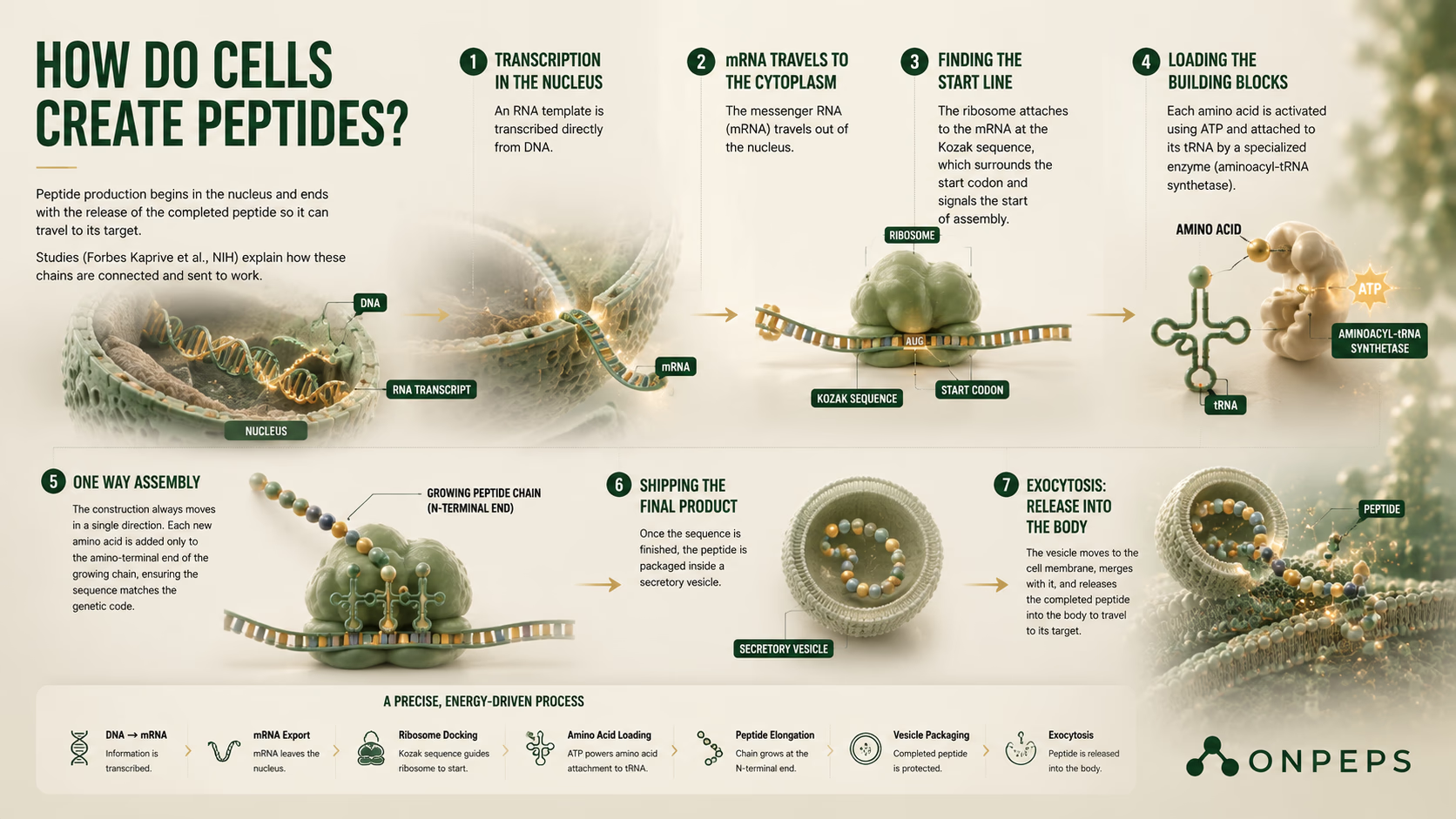
Research (Forbes Kaprive et al., National Institutes of Health) explains how these chains are linked and how they function. In living organisms, the synthesis process begins deep within the cell nucleus.
This article explains the complete process of how cells make peptides, step by step: transcription, translation, positioning, assembly, transport, and laboratory solid-phase synthesis.
1. From DNA to RNA Template
The first step in the synthesis process takes place in the cell nucleus. The RNA template is transcribed directly from DNA.
Messenger RNA enters the cytoplasm and then binds to the ribosome. Once the ribosome is in place, the cell must determine the exact starting point for linking.
This step determines the order of all subsequent amino acids. The accuracy of the template directly determines whether the final peptide chain sequence is correct.
2. Finding the Starting Line: The Kozak Sequence
The cell uses a physical marker to determine the starting point of synthesis. This marker is a specific sequence known as the Kozak sequence.
It surrounds the start codon and acts as a signal to guide the ribosome into docking and initiating the synthesis process.
Without this marker, the ribosome cannot accurately find the starting point, and peptide chain synthesis cannot begin correctly.
3. Loading the Building Blocks: ATP and Loading Enzymes
Each amino acid must be prepared before it can be added to the amino acid chain. This preparation process requires cellular energy, namely ATP.
A special enzyme acts as a biological loader, attaching each amino acid to a transport molecule. This enzyme ensures that the correct building blocks are ready to be fed into the assembly of the amino acid chain.
The key to this step is accuracy. Once a wrong amino acid is loaded, it may be incorrectly incorporated into the peptide chain, causing the final product to function abnormally.
4. One-Way Assembly: Only Added to the Amino Terminus
The assembly process always proceeds in a single direction. Each new unit can only be added to the amino terminus of the extending chain.
This strict rule ensures that the sequence matches the genetic code exactly.
One-way assembly means the synthesis process is highly directional, and the cell cannot randomly insert or adjust amino acids midway. This mechanism guarantees the fidelity of the peptide chain sequence.
5. Transport of the Final Product: Secretory Vesicles and Exocytosis
Once the sequence is synthesized, the peptide chain is packaged inside a protective vesicle called a secretory vesicle.
This vesicle moves to the edge of the cell and fuses with the outer cell wall. This process is called exocytosis.
It releases the synthesized peptide into the body, allowing it to reach its target. Exocytosis is the final step in moving a peptide from inside the cell to outside, and it is also the prerequisite for the peptide to exert its biological function.
6. Laboratory Manufacturing: Solid-Phase Synthesis
Scientists build these molecules in the laboratory using a method called solid-phase synthesis. They fix the first unit onto a solid support, then add new units through repeated chemical steps.
These steps involve coupling a new amino acid, then removing the protecting cap so that the next amino acid can be attached.
This laboratory technique enables the rapid production of custom sequences for medical use. Unlike intracellular synthesis, solid-phase synthesis does not rely on ribosomes; instead, it stitches amino acids together step by step through pure chemistry.
7. Summary
The complete process of how cells make peptides can be summarized as follows:
First, DNA is transcribed into an RNA template.
Second, messenger RNA binds to the ribosome, and the Kozak sequence determines the starting point.
Third, ATP provides energy, and loading enzymes attach amino acids to transport molecules.
Fourth, one-way assembly occurs, with new amino acids added only to the amino terminus.
Fifth, the peptide chain is packaged into a secretory vesicle and released outside the cell through exocytosis.
Sixth, in the laboratory, solid-phase synthesis can be used to rapidly produce custom sequences.
Understanding this process helps explain how peptides are generated and regulated in the body, and why an error at any step in synthesis can affect the function of the final product.
Frequently Asked Questions
What determines the starting point of peptide synthesis?
The Kozak sequence determines it. It surrounds the start codon and guides the ribosome into docking and initiating synthesis.
Why can peptide chains only be assembled in one direction?
Because each new amino acid can only be added to the amino terminus of the extending chain. This rule ensures that the sequence matches the genetic code exactly.
What is the role of secretory vesicles?
They package the completed peptide chain, transport it to the edge of the cell, and release it outside the cell through exocytosis.
What is the difference between solid-phase synthesis and intracellular synthesis?
Intracellular synthesis relies on ribosomes and an mRNA template, while solid-phase synthesis is a purely chemical method that fixes amino acids onto a solid support and stitches them together step by step, making it suitable for rapidly producing custom sequences.